On July 31, 1980 the Sex Education Planning Committee approved the 7th and 9th pilot sex education program for New Orleans Public Schools. The following school year, 1981-1982, the committee introduced the program for 8th and 10th grade. Dr. Brenda Garibaldi, the Director of Media for New Orleans Public Schools, led the Sex Education Materials Sub-Committee to preview and recommend materials for the pilot sex education curriculum. The subcommittee consisted of outside groups, such as Mayor Dutch Morial’s office, the National Council of Jewish Women, the Junior League, the Archdiocese of New Orleans, as well as school principals and librarians from Sophie B. Wright Middle School, L.B. Landry Senior High School, and McDonogh #35 Senior High School. Read the list of approved materials for grades seven through twelve here.
The sex ed course, which was adopted into biology, health, or home economics, was an opt-out model, requiring parents to remove their child from instruction. The pilot course was a four-week program during both fall and spring semesters. Six New Orleans public schools were invited to enroll in the pilot program. Dr. Julianna Boudreaux, Assistant Superintendent of Instruction and Child Advocacy for the New Orleans Public School System, intentionally limited the number of participating schools, wanting them to act as a test before expanding across Orleans Parish. 7th graders were introduced to puberty, personal identity, and anatomy. Classes were co-ed but were sometimes sex-segregated for students to more comfortably ask questions. Students were also more honest when questions were anonymous. The curriculum asked students about family relationships and dynamics. Students debated gendered statements such as “house work is for women, lawn work is for men, and the man is the head of the household.” The curriculum for 9th graders included human reproduction, which would act as review after the program became recurring. In the 9th grade guide, educators introduced students to contraception and STIs. The curriculum outlined abstinence as well as contraceptive methods for both men and women. Read the full 7th grade guide here and 9th grade one here.
The 1988 sex education curriculum kept a focus on Family Living Education, or parenthood and family relations, and covered AIDS for grades 7-10. In the Orleans School Parish School Board records, only the pilot sex education curriculum is included. It is likely that the curriculum did not significantly change until the AIDS crisis. Health teachers, school nurses, and curriculum specialists from across the district developed the curriculum titled “Educator’s Guide to Health and Family Living with AIDS.” The guide provided students with Louisiana-specific information on AIDS, including reported cases since 1982. Students also researched agencies, including local organizations, to know where AIDS resources were available.
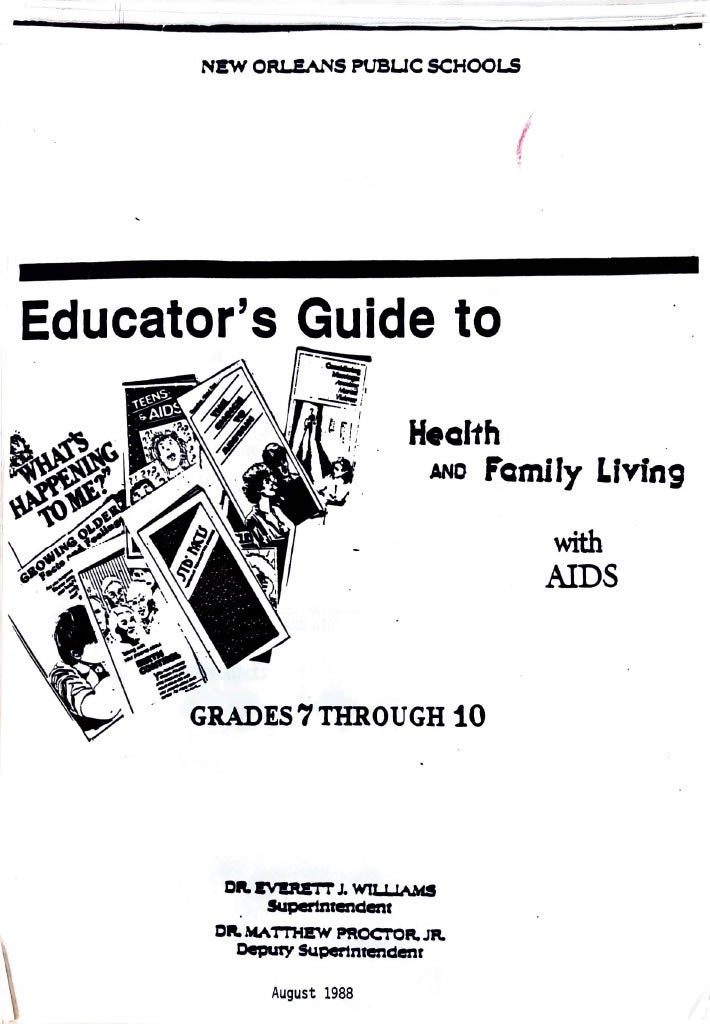
Curriculum Writing Team, “Educator’s Guide to Health and Family Living with AIDS: Grades 7 through 10,” 1988. Planned Parenthood Collection, NA-303. Box 2, Folder 37. Newcomb Archives and Vorhoff Collection, Tulane University, New Orleans, LA.
7th and 8th grade students focused on anatomy, dating, and STDs. The AIDS lessons centered on the disease’s origins, people affected, and prevention. 9th grade students were introduced to birth control. They also learned about the symptoms of AIDS as well as the disease’s myths versus facts. Across all grades, the 1980 and 1988 curricula emphasized abstinence but were not abstinence-only-education. Both the 1980 and 1988 guides named contraceptive methods, from the diaphragm to oral contraceptives. The 1988 guide invited a guest speaker from a local right-to-life organization and a Louisiana Family Planning Program representative to present methods of contraception. Students were then encouraged to discuss “pros and cons of abortion.”
The 1988 guide for 10th grade reviewed STDs and birth control and emphasized marriage. The guide acknowledged that there are reasons for being single but also disadvantages, such as being considered “an old maid, gay, and a swinger.” The guide includes reasons to marry and lists “sexual desire and satisfaction,” the only mention of sexual pleasure in the curriculum. The guide mentions masturbation but does not mention pleasure. However, the 1980 guide for the 7th grade expresses that the practice results in pleasure.
Both teaching guides from 1980 and 1988 mention abortion. The 1980 guide only lists types of abortions, such as “spontaneous abortions” or miscarriages, and legal abortions. Although the 1988 guide appears neutral by inviting both a pro-life and pro-choice speaker, the lessons hint otherwise. In a 10th grade test, a question read “True or False: Abortion is not a responsible informed solution to child bearing, simply a social alternative.” The answer is “True.”

Question from 1988 Curriculum Guide for 10th Grade, pg 78.
The start of the 1980 school year was the first time that many New Orleans public school students received sexual education. With the passing of Act 480 permitting schools to offer sex ed, few students in Orleans Parish had received any formal sex ed in schools. According to Dr. Boudreaux, some schools taught human reproduction in biology, but many were afraid to teach on any aspect concerning reproduction due to the sex ed ban’s stiff penalties. The 1988 curriculum reflected the continued teaching of FLE and progression of the AIDS crisis, which hampered calls to eliminate sex ed in schools. The following section examines resources available to youth outside of the classroom.