On January 15, 1967, New Orleans Public Schools proposed a sex education program under Title III of the Elementary and Secondary Act of 1965. Orleans Parish chose Dr. Robert M. Doud to oversee the six schools in the pilot program. After sending a parish-wide survey to voters, Doud was assured by the results: the majority of parents favored the initiative. However, opposition began to organize.
In March of 1969, Dr. Gordon Drake, author of Is the School House the Proper Place to Teach Raw Sex, spoke before the group Concerned Parents in New Orleans. Speakers, like Drake, and a flood of anti-sex ed pamphlets furthered parental suspicion about the program. Pushback soon influenced state policy. Parents were also active in preventing sex ed in schools. POSE, or Parents Opposed to Sex Ed, was a nationwide group that had a chapter in New Orleans. The group condemned the pilot program, believing it corrupted children’s morals. In May of 1969, Representative Frederic Hayes’ bill, prohibited the state from funding sex ed below the ninth grade. State efforts to limit sex ed culminated in June when the legislature placed a ban on sex ed in public schools, regardless of grade level. If teachers disobeyed, the law outlined punishment. According to the act, offending parties risked no pay for up to 60 school days. If the school failed to carry out disciplinary action, then the State Board and Department of Education were to withhold all funds to the school until it complied. The resolution barred sex ed, pending a report to the 1970 general session. The following May, the legislature upheld the ban. Critics argued the legislation was too vague, resulting in schools questioning what they were allowed to teach. In July 1973, Attorney General William Guste ruled that a venereal disease program did not constitute as sex ed, allowing the program for high school students in the state.
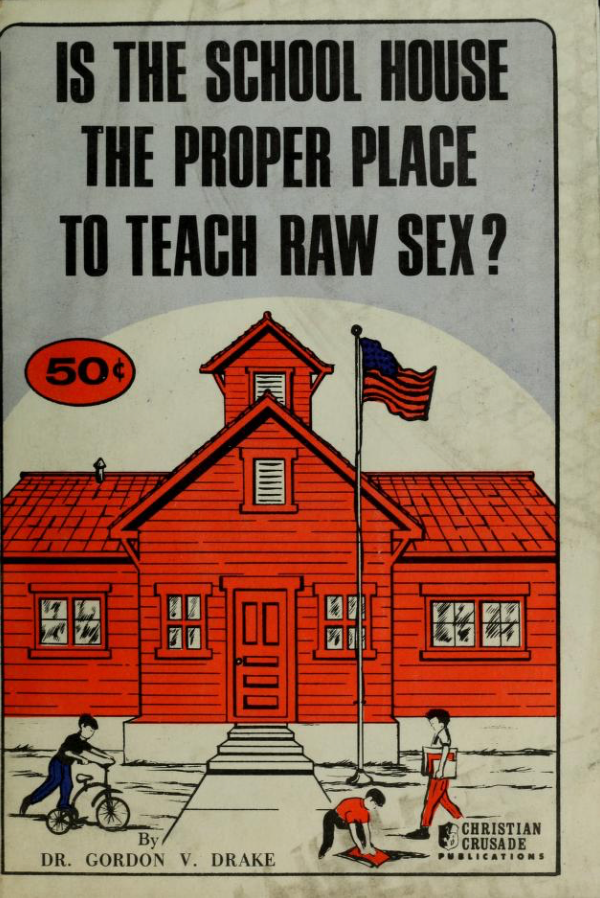
Drake, Gordon. Is the School House the Proper Place to Teach Raw Sex. Christian Crusade Publications, 1968. Personal Collection, New Orleans, LA
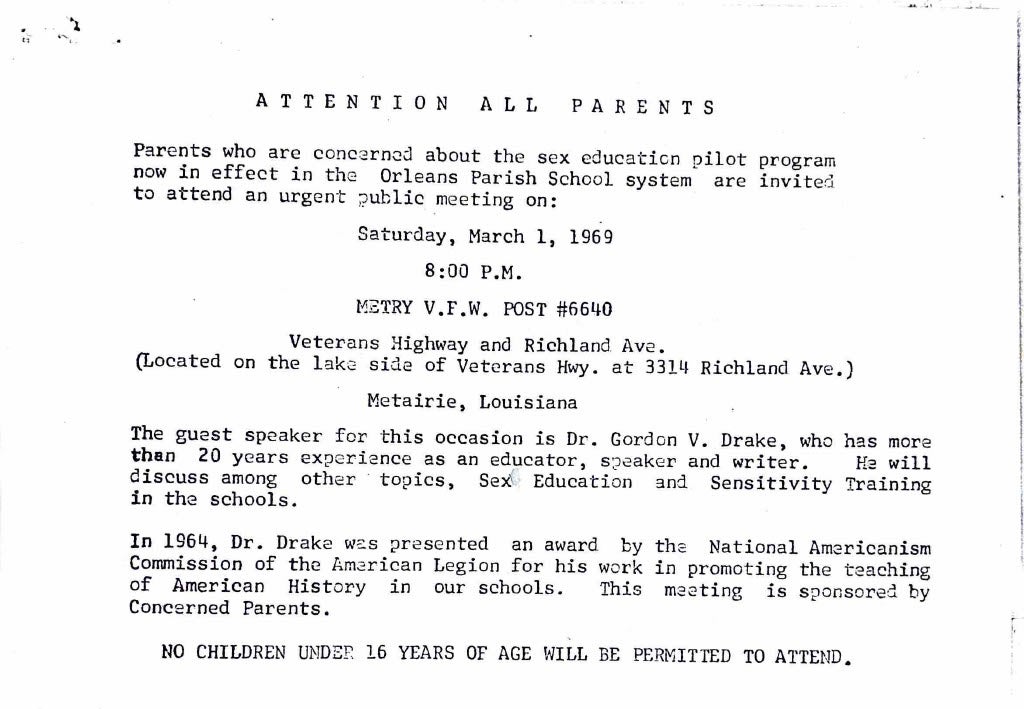
Concerned Parents, “Attention All Parents,” 1969. Orleans Parish School Board Collection, MSS 147. Box 92, Folder 1966-1975. Earl K. Long Library, The University of New Orleans, New Orleans, LA.
Organizations across the state and in New Orleans fought for a decade to finally bring sex ed into schools. Since the 1970s, the American Civil Liberties Union (ACLU) of Louisiana has challenged the state’s restrictive sex ed laws. In 1976, Joel Aber, a biology teacher, contacted the ACLU of Louisiana to contest the suppression of sex ed in schools. Teachers, like Aber, believed the statute interfered with their responsibility to give students comprehensive information about their bodies. Local groups were also restricted from educating young people. The Young Women’s Christian Association (YWCA) of New Orleans ran a rape crisis center. Since the sex ed ban prevented the organization from giving students lectures on rape, women of the YWCA advocated for legal change, ensuring that rape education be exempted from the ban.
Young Women’s Christian Association, “YWCA Rape Crisis Service,” New Orleans YWCA Records, LaRC-637. Tulane University Special Collections, Tulane University, New Orleans, LA.
During the ban, members of the state legislature sponsored legislation to lift the ban. From 1972 to 1979, Shreveport Rep. Alphonse Jackson introduced bills to permit sex ed in public schools. When Jackson’s bill came before the legislature in 1974, it failed again, but his bill to create a sex ed task force passed. The Times-Picayune reported that the legislature formed the group “as a means of handling a hot potato.” The task force was to form a recommendation on sex ed and was barred from using the Sex Information and Education Council of the United States, or SIECUS, when forming a decision surrounding the subject’s legality. In 1964, Mary Calderone, who would later become the first female medical director of Planned Parenthood, and a coalition of educators and parents founded SIECUS. Anti-sex ed crusaders, like Dr. Gordon Drake, publicly criticized SIECUS.
In March of the 1975 legislative session, the task force, composed of educators and private citizens, recommended allowing sex ed in schools with parental permission. In a news conference days after the recommendation, Governor Edwin Edwards made comments agreeing with the task force. However, when directly asked about his stance, Edwards quipped “I’ve been governor three years, and you’re going to wait until an election year.”