Many sex ed organizations in New Orleans have failed to recognize issues related to sex education. In 1989, sponsored by the National Institute of Mental Health, several local organizations formed “Kujichagulia,” which means “self-determination” in Swahili. Commonly known as the Kuji Center, the group aimed to reduce the rate of teen pregnancy in the city, especially in the St. Thomas housing project. Barbra Major, the former chair of the St. Thomas Consortium expressed that “the Kuji Center was not created around teen pregnancy. It was created around building in our young people a worthfulness.” Find a clip from Major’s oral history below about the Kuji Center.
In a majority Black neighborhood, St. Thomas residents grew tired of outside social service providers claiming to fix their problems. The residents formed the St. Thomas/Irish Channel Consortium to create their own solutions, as seen with the Kuji Center. Instead of forming new groups for Kuji, the consortium formed partnerships with ones already in the community, including the St. Thomas Residents’ Council, Greater New Orleans Ministries, the People’s Institute, Bridge House, Hope House, and Tulane University’s School of Public Health. The only requirement to join was participating in an “Undoing Racism” workshop conducted by the People’s Institute in New Orleans.
Planned Parenthood was one of the many partners that made up Kuji. The center encouraged New Orleans youth, both boys and girls ages 11 to 18, to participate in sex ed activities such as the “Family Life and Sexuality” class taught by Dr. Sams-Abiodun, the previous Director of Education at Planned Parenthood Gulf Coast. Find an audio clip from Dr. Sams-Abiodun’s oral history below and her involvement with the Kuji Center.
In an interview from Southern Exposure magazine in 1996, Major expressed that when applying for funding, the center “would not apply to any foundation that sees teen pregnancy as our number-one problem-because it’s not. Teen pregnancy is an offshoot of structural problems. We wanted to look at racism and leadership development.” The center also aimed to lower infant mortality rates, delay sexual encounters for young men and women, and decrease rates of STIs.
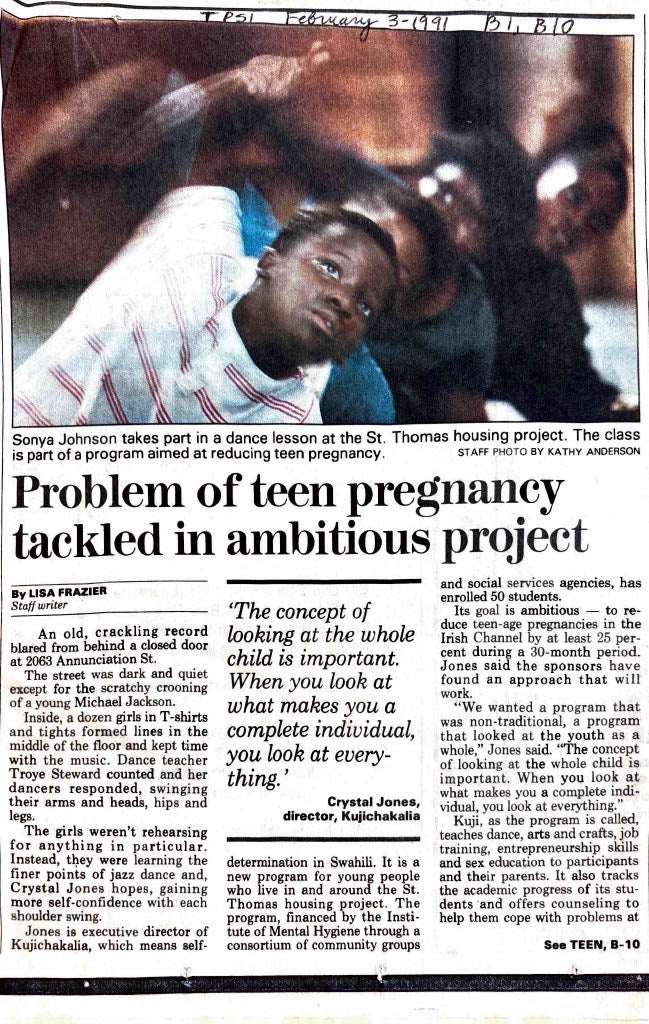
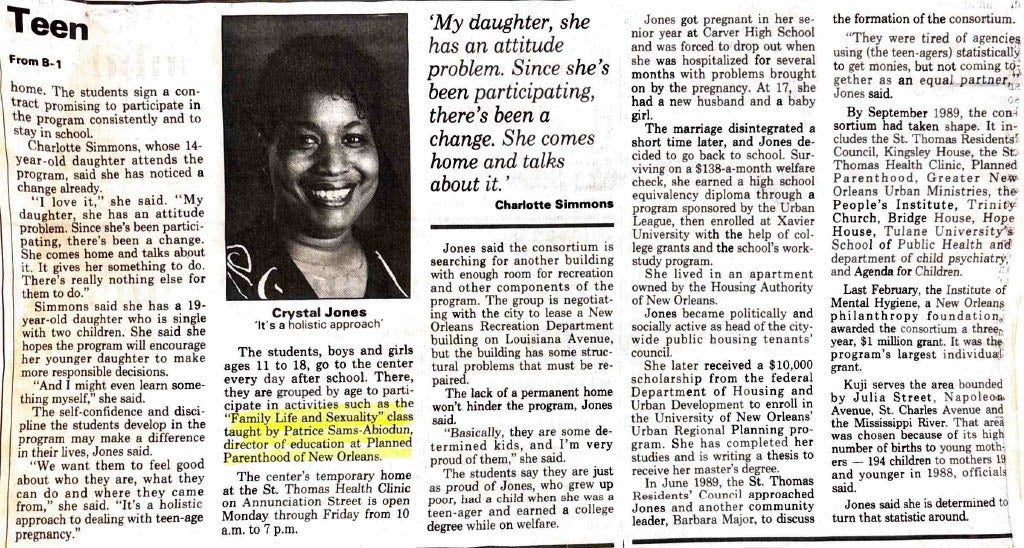
Frazier, Lisa, “Problem of Teen Pregnancy Tackled in Ambitious Project,” Times-Picayune, 1990?, Planned Parenthood Collection Records. NA-303, Newcomb Archives and Vorhoff Collection, Tulane University, New Orleans, LA.
Crystal Jones, the center’s executive director from 1990 to 1996, told the Times-Picayune that she “wanted a program that was non-traditional, a program that looked at the youth as a whole.” Raised in Louisiana, Jones became pregnant during her senior year at Carver High School in New Orleans. After giving birth to a baby girl and separating from her husband, Jones earned a high school equivalency diploma and later a master’s from the University of New Orleans’ Urban Regional Planning program, while leading the city-wide public housing tenants’ council. When the St. Thomas Residents’ Council approached Jones in June 1989 to join Kuji, she was more than qualified to help manage the program because of her social activism and personal experience.
The Kuji Center was a radical departure from previous organizations. When Kuji launched in 1989, the Times-Picayune lauded the center as “an intense $1 million experiment.” The center recognized that decreasing rates of teen pregnancy extended beyond the classroom. The center taught dance, art, job training, and entrepreneurship skills. Kuji staff also provided health services, including child care, occasional dinners, and doctors and nurses at the center once a week. Kuji also ensured that the teens in the program made a commitment to their academics. When teens joined the program, they agreed to stay in school and consistently participate at the center. By instilling self-confidence in New Orleans youth, the local organizations and activists that made up Kuji created a program that uplifted teens to make long-lasting healthy decisions.
After the federal and local housing agencies demolished the St. Thomas housing development between 2001 and 2002, the Kuji Center closed. Reflecting on the impact of the Center, Major feels hopeful thinking about the “self-empowered folk scattered all over this country.” She believes “there’s a wisdom in communities that we overlook, and we have for a long time… Lifting the joy of a community… that was the gift of the Consortium.”